

Movierooms – Cinema Management | PC Early Access Review
An innovative first offering, Movierooms – Cinema Management by indie studio Mad Pumpkins is a twist on the traditional management-sim genre of games. Mad Pumpkin has created homage to cinema across eras, nations, and points in cinematic history.
Movierooms offers an accessible management game for gamers who happen to be avid fans of classic films, but also those who like the idea of management sims without an overwhelming focus on granular details.
Journary through Cinematic History
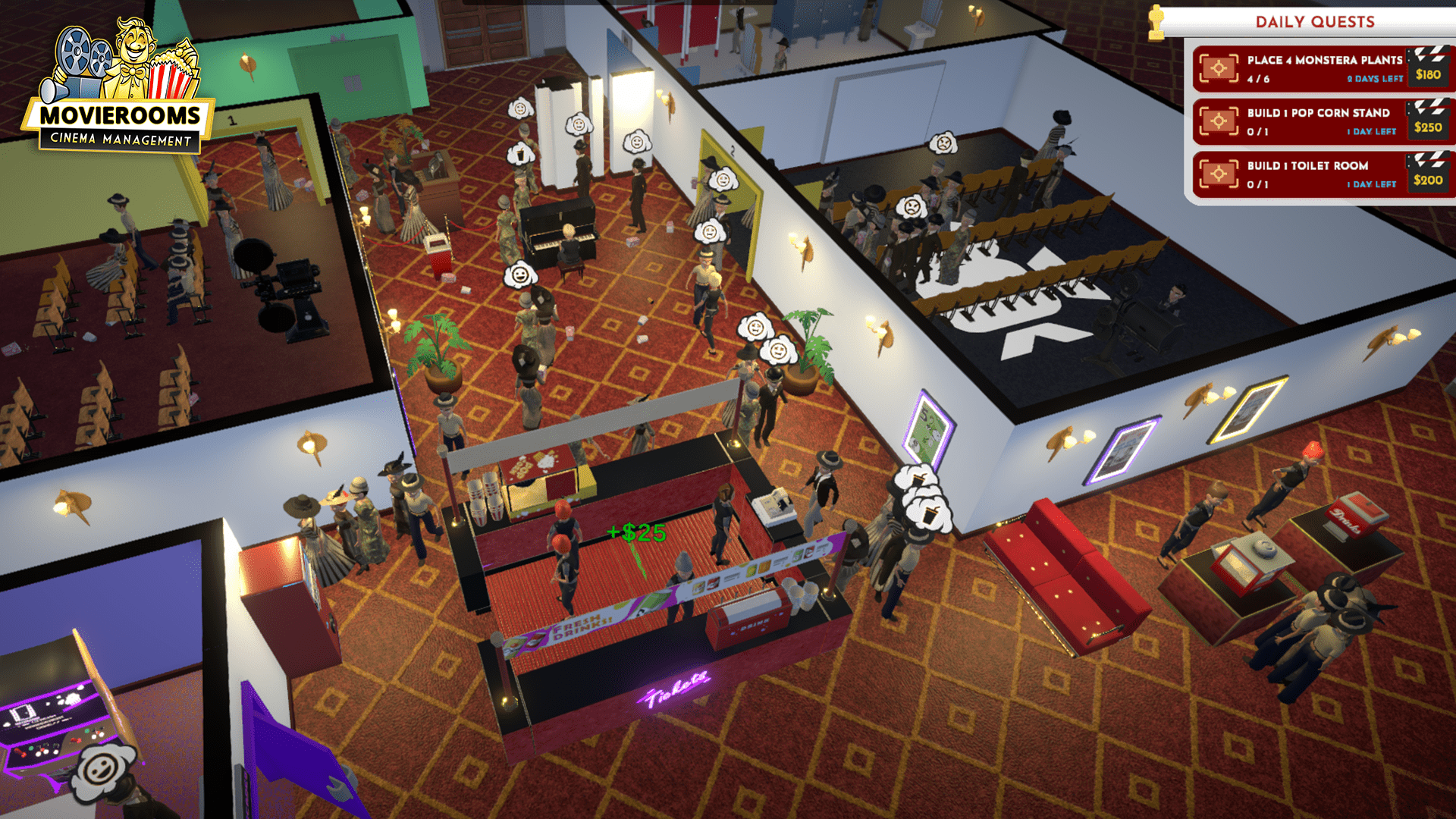
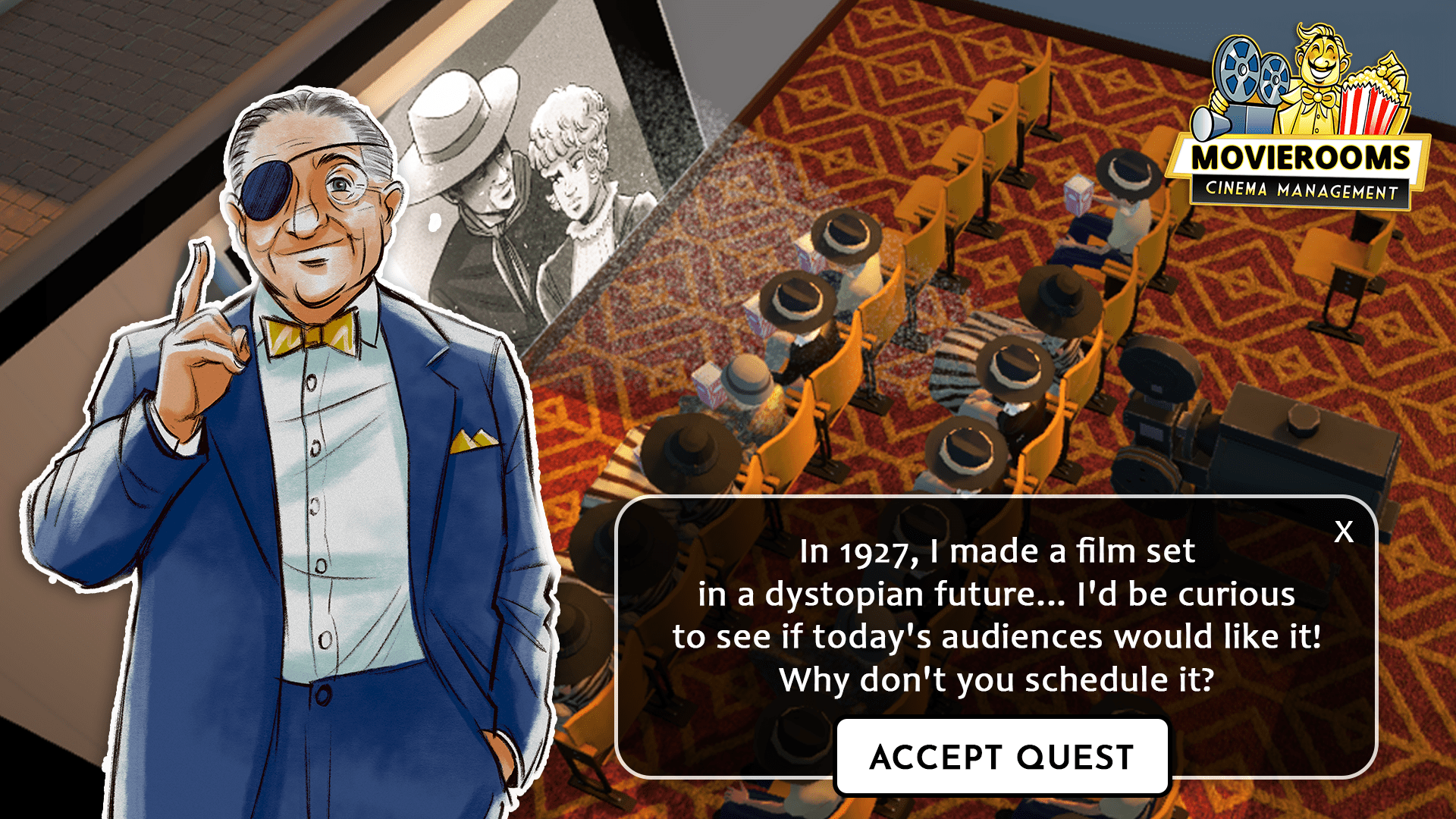
Right out of the gate, players will find themselves ushered into a time walk through history. Starting in the turn of the 19th century France, Movierooms introduces players to the game’s fundamentals. There players will see, purchase, and place their first Magic Lantern style projector. Players will be tasked with setting up their first projection room and equipping it. This level functions as the in-game tutorial and a succession of tasks will take the player through all the things needed to operate a theater. One of those main tasks is selecting from a catalogue of time-period accurate movies such as Hilarious Phases of Funny Faces or A Launch to the Moon. As the player progresses, they will be able to progress further down the cinema timeline encountering artists, time periods, and locales along the way.
Movierooms keeps the gameplay interesting. You can expect each time period in your playthrough to come with period specific mechanics. In the 1900’s France segment, players will find they are using what we would today call antique lantern style projectors which for their time were cutting edge. While the game is built on the framework of creating and managing an operational theater, the tie-ins of period artists and era-accurate films keeps the game engaging throughout the playthrough.
Behind the Curtains
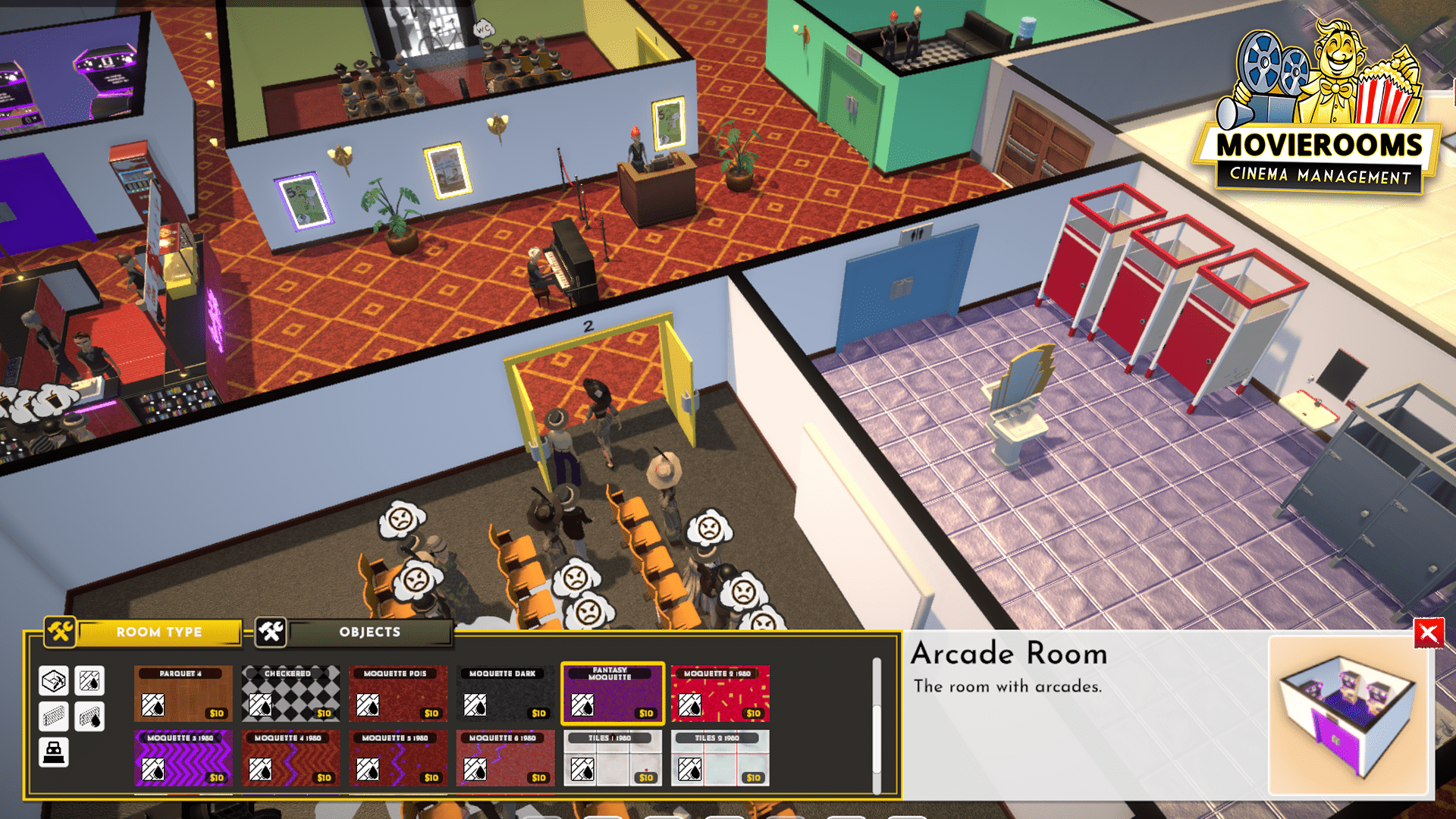
The mechanics of the game are straightforward. Players will be able to use a mouse and keyboard to comfortably navigate the game. Movierooms utilize a click-and-drop system where the player can drop a desired object such as a popcorn stand anywhere in the theater, while being able to rotate the object and see key indicators such as employee and customer interaction points. Theaters start off as open ground where projection rooms for individual theaters, bathrooms, breakrooms, and eventually arcades are drop-and-drag. The in-game menus are easily navigated, with the most needed information typically being found on the top level of each menu. The game features a play and pause with speedup system familiar to players of other management sims or RTS games. The game features a straightforward system of profit versus loss with basic upkeep mechanics. Employees need to be paid, equipment repaired, and the theater supplied. At times the object degradation mechanic felt too quick, especially in the Sandbox mode where I found myself repairing projects and ticket counters several times throughout the day or even outright replacing them to keep up with the rate of decay.
Cinematography
The game features an art style that is soft and not overly realist nor overly exaggerated. Placeable objects are clear and easy to distinguish and NPCs are somewhat cartoonish. The game runs easily at 120 + FPS. However, the in-game resolution settings will need to be adjusted to fit as the default resolution starts off small and causes UI elements to overlap and be unusable.
The music in Movierooms can best be described as easy listening stylized to the period. Gameplay from 1900 featured a carnival themed soundtrack while the 1930’s led with a swing theme featuring a new focus on brass. While the soundtrack did not change tracks in each period, the track did evolve over time. Admittedly the tracks are loud and after a while I found myself wanting to turn them down as they became too repetitive in sound.
Movie Critics Reviews are In.
Overall, Movierooms was an enjoyable experience. I enjoy management sims and with the peppering of real-world references to history’s great artists and films, I found the game to be engaging. What I like most as a player who increasingly does not have the time to spend hours on end learning mechanics was the balance of granularity. Management of the theater was granular down to the point of basic income/loss, customer satisfaction, and scheduling. However, the game never became overly complex in that granularity to the point where learning mechanics takes the place of enjoying the overall game. That is, to me, what makes the experience fun. Movierooms does not take itself too seriously and instead offers a playful homage to great cinema packaged in a management sim.
This review is based on a PC copy of Movierooms provided by JF Games Agency for coverage purposes. As of this writing, it is exclusive that platform.