
Clockwork Ambrosia | PC Review
Clockwork Ambrosia, from developer Realmsoft, asks the simple question of “what if you had a Metroidvania, but with highly customizable guns?” The answer: a pretty good game, but one with some flaws.
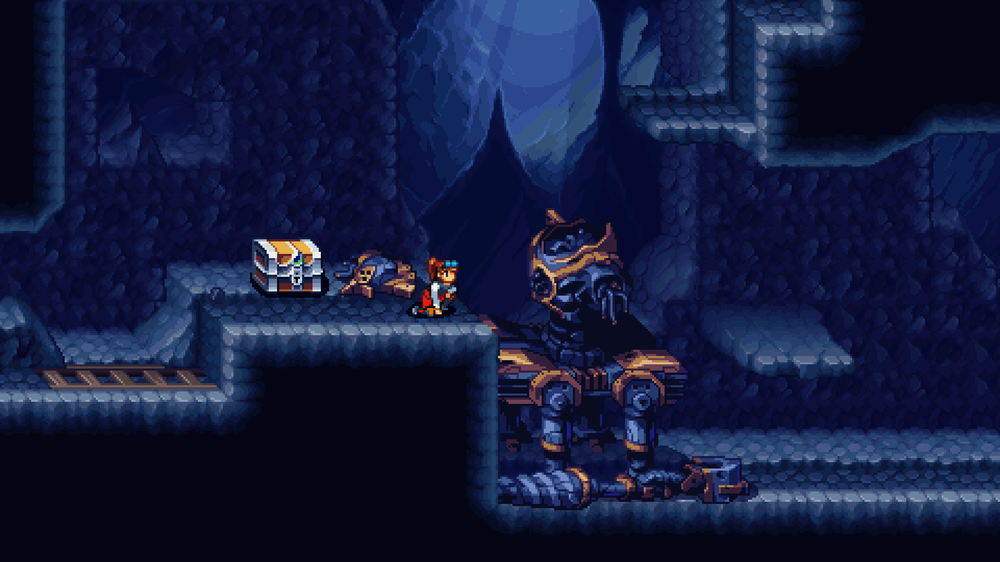
Lost A Perfectly Good Zeppelin
Clockwork Ambrosia starts out simple: you’re flying around in your steampunk zeppelin, easy-breezy, and then a robot dragon shoots you out of the sky. Darn. Better get to running and gunning! The plot of the game is essentially an excuse for there to be a game in the first place. The main character Iris is sort of thrust into the action by virtue of having been in the wrong place at the wrong time, which is fine as a starting point, but you don’t learn much of anything about Iris other than she presumably wants to get off this island full of killer robots.
Still, let it not be said we come to a metroidvania for the plot. No, we come here for the power-ups and the shooting and the explosions! And there are plenty of those to go around. Iris starts out with a pulse blaster, a simple firearm that can charge up a shot for additional damage, and eventually finds a rocket launcher, grenade launcher, and a pair of six-shooters. You can alter the behavior of these weapons through various modifiers you’ll find practically littered around the world. Some mods do simple things like add additional rounds of ammunition, while others will change what direction your shots fire, or add additional bullets per shot or set enemies on fire. Combining these mods in these guns can cascade into some absolute silliness, like rockets that fire, fall and bounce along the ground, and then burst into a sprinkler of explosions. Is it effective? God no. Is it funny? Of course!
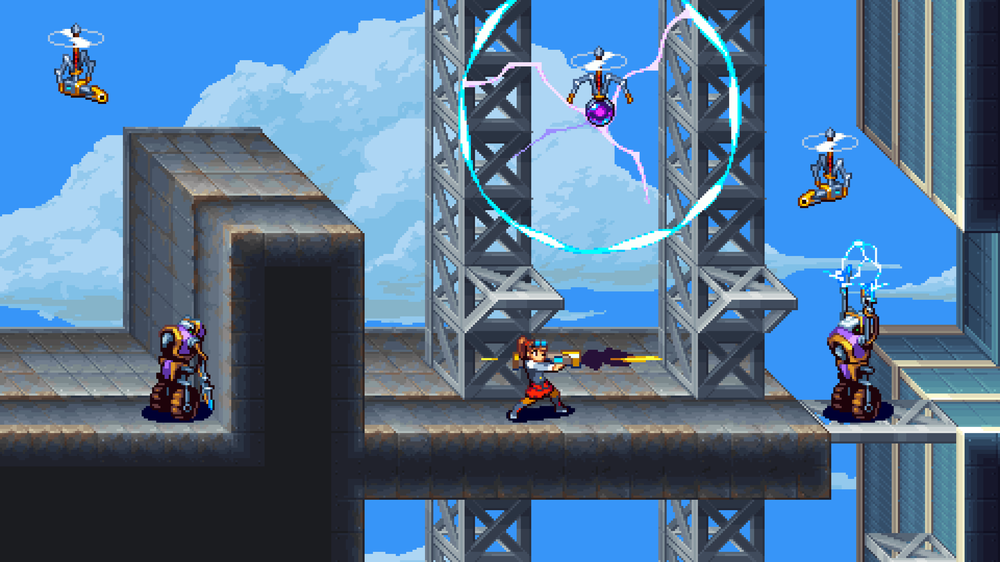
Make Gun Good. Now Make Gun Silly.
Though the sheer number of mods encourages tinkering and experimentation, it’s not until the latter part of the game when you’ll really get into the meat of the system, which works against it. Many of the mods you’ll find are unfortunately gimmicks rather than anything you’ll use in a practical sense. The rocket launcher, for instance, has a mod that increases the number of rockets you can fire which you find quite early in the game, and it’s unlikely you’ll ever want to take it off. The pulse blaster has mods that change the charge shot behavior or create a spread shot, but many others require specific combinations you may not have access to yet.
This seems to be a trend with the game, as access to fast travel isn’t unlocked until well into the game. It’s not too bad at first since you’ll be going into new areas often, but eventually you’re going to be wondering when you get to quickly zip back to town to do some shopping before exploring. The fact that enemies tend to be very bullet-spongy also discourages heavy backtracking, as many are also difficult to avoid. Iris herself isn’t terribly nimble, despite a dash ability and various other movement tech you can unlock. Fast enemies tend to get the better of her, at least until you acquire more abilities that let you better dodge attacks. Likewise, wall jumping just launches you in the opposite direction of said wall, which makes platforming with it feel janky at times.

Clockwork Ambrosia Final Verdict
It all culminates in a game that’s built around a core concept (a metroidvania with lots of loot to find and highly customizable weaponry) that doesn’t quite nail the ancillary systems, like satisfying combat or quality of life features. It’s not bad by any stretch, but outside of the weapon mod system and the pixel art style, there isn’t too much that sets Clockwork Ambrosia apart from the pack of Metroidvanias. It’s certainly fun tooling around with new mods and getting new abilities, but the game makes it more tedious than should be necessary to backtrack, which goes counter to the idea that you should criss-cross the world as you unlock new movement tech. Still, it’s worth taking a look, as the core game is still satisfying if you can look past its flaws, plus the dev team is actively working on improvements. For a price of $20 USD, you get a game of about 15-20 hours that’ll at least let you see how utterly bananas you can make a rocket launcher.
To hear me talk more about Clockwork Ambrosia, be sure to listen to the May 30th, 2026 episode of The Gaming Outsider Podcast around the 1:22:17 time stamp.
This review is based on a PC copy of Clockwork Ambrosia provided by the developer for coverage purposes. As of this writing, it is exclusive to that platform.
Clockwork Ambrosia
$19.99
Pros
- Highly Customizable Weapons
- Plenty of Treasures and Secrets to Find
Cons
- Paper-Thin Story
- Many of the Game’s Systems Take a While to Fully Unlock
- Movement Tech Could Be More Snappy